TFLAC
JULY 2026
The debut edition.
Welcome to the TRIPLE FIGHT LIBRARY AND ARCHIVAL CENTER (TFLAC) — a department of the TRIPLE FIGHT MUSEUM (TFM).
IMAGE of the Month
Each month, TFLAC supports the Museum’s mission by presenting an item from its Collection that leads to further discoveries about the world, boxing, print culture, and social history from 1890 through 1929.
Image of the Month
July 2026
AMERICAN FIGHTERS
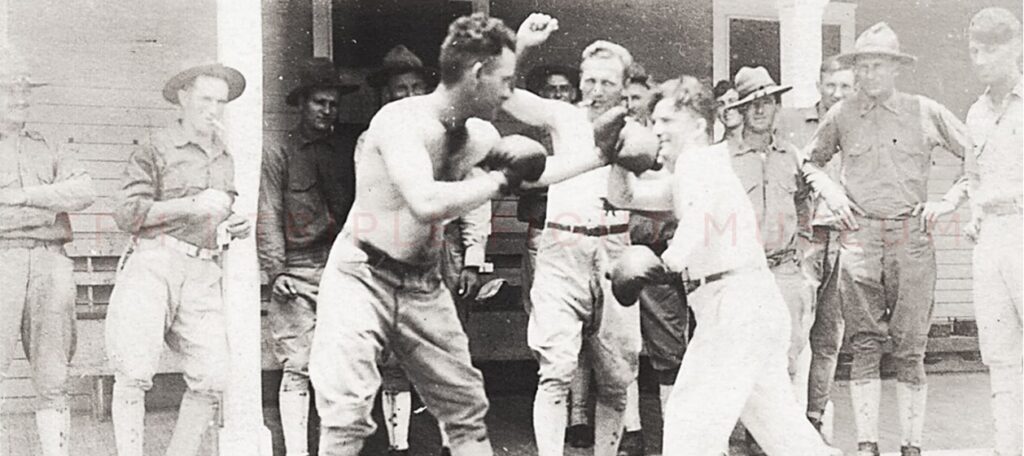
Above is a cropped view of a real photo postcard (RPPC) held in the TFM Collection. The postcard depicts a pair of World War One-era U.S. Servicemen ready to engage in a round of boxing as fellow Servicemen look on with varying degrees of interest. During the Great War, as WW1 was known in its time, the U.S. military encouraged servicemembers to engage in boxing as a form of combat training, conditioning, entertainment, and a “safe” way to settle disputes. Boxing and the U.S. Military are one example of how Fights in Rings (F1) and Fights Among Nations (F2) converged during the four decades that define THE TRIPLE FIGHT (1890-1929). When one considers the military’s adherence to a policy of segregation during those decades, the third element of THE TRIPLE FIGHT: (F3)-Fights for Equality and Justice, comes to the fore to guide our study of America’s past. This is the work of THE TRIPLE FIGHT MUSEUM to gather, preserve, interpret, and amplify histories containing lessons that speak to us today. The TRIPLE FIGHT Library and Archival Center (TFLAC) exists to ensure every item in the TFM Collection is properly cataloged and accessible for study and presentation.
CONNECTING THE DOTS
TFLAC enables TFM to show visitors how items centered in one part of the collection, or time period, relate to one or more items in another part of the collection or time period. For example, the image shown above, selected as the featured image for July 2026, corresponds to the postcard image below. The two postcards are from the same period and show American Servicemen boxing at camp, but the postcard below adds a new dimension, something worth noting. Look closely and see if you can identify a new pathway for further discovery.
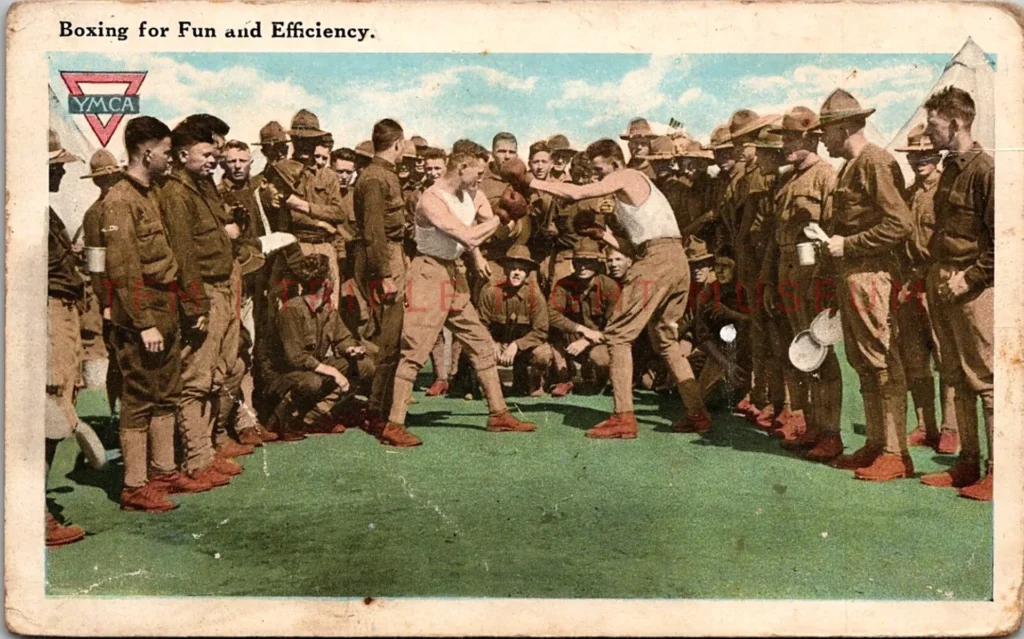
Do you see it? If you are still wondering what the new pathway of discovery could be, consider how the two postcard images are similar and how they differ.
Similarities: We already noted that the two postcards are from the same period and depict a group of servicemen gathered around two who are boxing, but that might be where the similarities end.
Major Differences: The top postcard was developed from a black-and-white photo snapshot, probably photographed by an amateur photographer who was also a servicemember. The other postcard is in color, was commercially produced, and depicts a scene that might have been staged but was most likely captured by a professional photographer using professional-grade equipment, perhaps at or near state-of-the-art quality for that time.
Two New Pathways of Discovery: Considering the physical differences between the two postcards opens the door to insights into their distinct intents. The first postcard was created to capture a fun moment from training camp. The intended purpose was to furnish a memory for future recall and reflection, and to share that moment with friends and loved ones back home. The colored postcard serves an entirely different function. Its image is not a close-up, like the first postcard. It is distant and remote, yet still conveys a boxing scene. The postcard also bears a title: Boxing for Fun and Efficiency. In that title is a message that says, yes, we box here, but for a purpose, to promote fun and efficiency. What kind of efficiency? The postcard does not say explicitly. The word is coded by design to soften the nature of the exercise. This makes the second postcard a recruiting document, a piece of propaganda packaged as a postcard. Did you notice the YMCA logo? Why is it there? What did the YMCA have to do with boxing, the U.S. Military, and World War I? This line of questioning forms another distinct path of discovery.
In this presentation of two postcards, we identified not one but two pathways for new discoveries. The two pathways involve: 1) examining postcard-messaging with boxing themes during the First World War, and 2) exploring the role of the YMCA in American society and its participation in America’s war effort.
By studying and comparing items from the past, we make fascinating discoveries weekly at TFLAC, and we delight in sharing some of them with you on this platform.
If you value the information presented here, please let us know. Click here and share your thoughts.
See More